
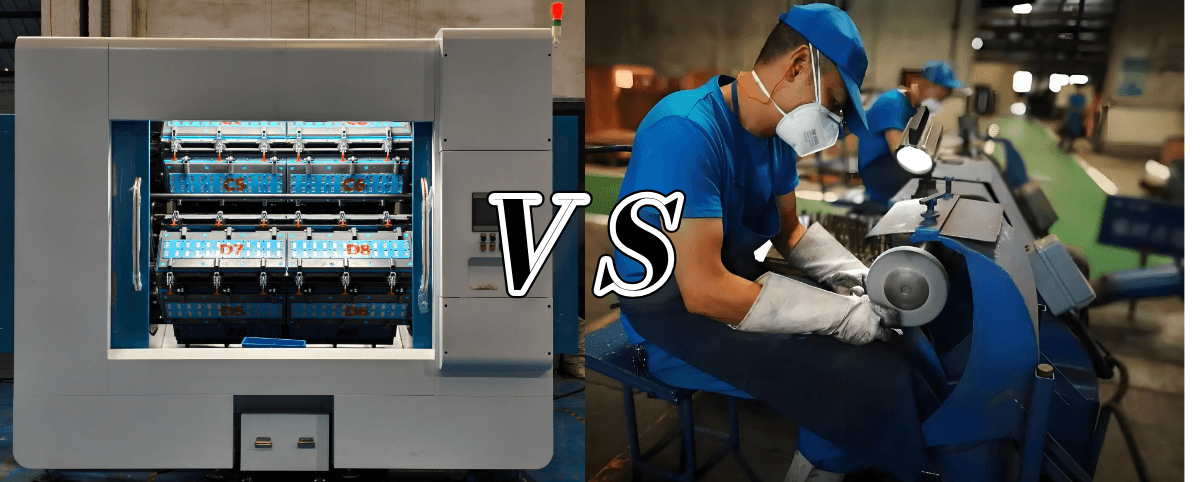
Traditional Polishing Methods vs Automated Polishing Machinery in Industrial Production
Introduction
Polishing is a critical surface finishing process in modern manufacturing, especially in industries that rely on high-quality metal polishing. For decades, traditional polishing methods dominated workshops and factories, relying heavily on manual labor and operator experience. However, with the rise of industrial production, manufacturers are increasingly adopting automated polishing machinery to improve efficiency, consistency, and cost control.
Understanding the differences between traditional polishing methods and automated polishing systems is essential for manufacturers seeking low-cost polishing solutions and long-term competitiveness. This article provides a detailed comparison to help decision-makers choose the most suitable polishing approach.
1. Overview of Traditional Polishing Methods
Traditional polishing methods are primarily manual or semi-manual processes. Operators use handheld tools or basic polishing machines to finish metal surfaces based on personal experience and skill.
Key characteristics include:
High dependence on skilled workers
Significant variation in surface quality
Limited scalability for mass production
Labor-intensive operation
While traditional polishing can be effective for small batches or customized products, it often struggles to meet the demands of modern industrial production.
2. Overview of Automated Polishing Machinery
Automated polishing machinery replaces manual operations with programmable and repeatable processes. These systems use controlled parameters to achieve consistent surface finishes across large production volumes.
Typical features include:
Precise control of pressure, speed, and polishing time
Minimal operator intervention
Continuous and stable operation
Compatibility with automated production lines
Automated polishing systems are designed specifically for manufacturers aiming to improve efficiency and standardization.
3. Comparison of Labor Requirements
Labor cost is one of the most significant differences between traditional and automated polishing.
Traditional polishing:
Requires experienced operators
Long training periods
High labor intensity and fatigue
Difficult workforce management
Automated polishing machinery:
Reduces dependence on skilled labor
Shortens training time
Allows one operator to manage multiple machines
Significantly lowers labor costs
For manufacturers seeking low-cost polishing, automation provides a clear advantage.
4. Productivity and Output Efficiency
Traditional polishing methods are limited by human speed and endurance. Output fluctuates depending on operator skill and working conditions.
In contrast, automated polishing machinery offers:
Faster and more stable cycle times
24/7 operation capability
Higher throughput per unit of labor
This makes automated polishing far more suitable for high-volume industrial production environments.
5. Quality Consistency and Repeatability
Quality consistency is difficult to maintain with traditional polishing. Variations in pressure, angle, and technique often lead to uneven finishes and rework.
Automated polishing systems ensure:
Uniform polishing parameters
Repeatable surface quality
Lower rejection and rework rates
Consistent metal polishing quality not only reduces costs but also improves customer satisfaction and brand reputation.
6. Cost Structure and Long-Term Economics
Although traditional polishing requires lower initial investment, its long-term costs are often higher due to labor expenses, inefficiencies, and quality losses.
Automated polishing machinery involves higher upfront cost but delivers:
Reduced labor expenses
Lower scrap and rework rates
Predictable operating costs
Over time, automated systems provide superior return on investment and support sustainable industrial production.
7. Scalability and Production Flexibility
Scaling traditional polishing operations requires hiring and training additional workers, which increases cost and complexity.
Automated polishing machinery allows manufacturers to:
Increase capacity by adding machines
Maintain consistent quality at higher volumes
Adapt more easily to changing production demands
This scalability is essential for manufacturers planning long-term growth.
8. Safety and Working Environment
Manual polishing exposes workers to dust, noise, vibration, and repetitive strain injuries.
Automated polishing systems improve workplace safety by:
Reducing direct human exposure
Incorporating dust collection and safety enclosures
Creating cleaner and more controlled working environments
Improved safety reduces indirect costs related to health, compliance, and workforce turnover.
Conclusion
The comparison between traditional polishing methods and automated polishing machinery clearly demonstrates why automation has become the preferred choice in modern industrial production. While traditional polishing may still suit small-scale or customized applications, it cannot match the efficiency, consistency, and cost advantages of automated systems.
For manufacturers focused on metal polishing, low-cost polishing, and scalable production, investing in advanced polishing machinery is a strategic step toward long-term competitiveness and operational excellence.